


Reducing a Felony Sex Crime Conviction to a Misdemeanor Pursuant to Penal Code Section 17(b)
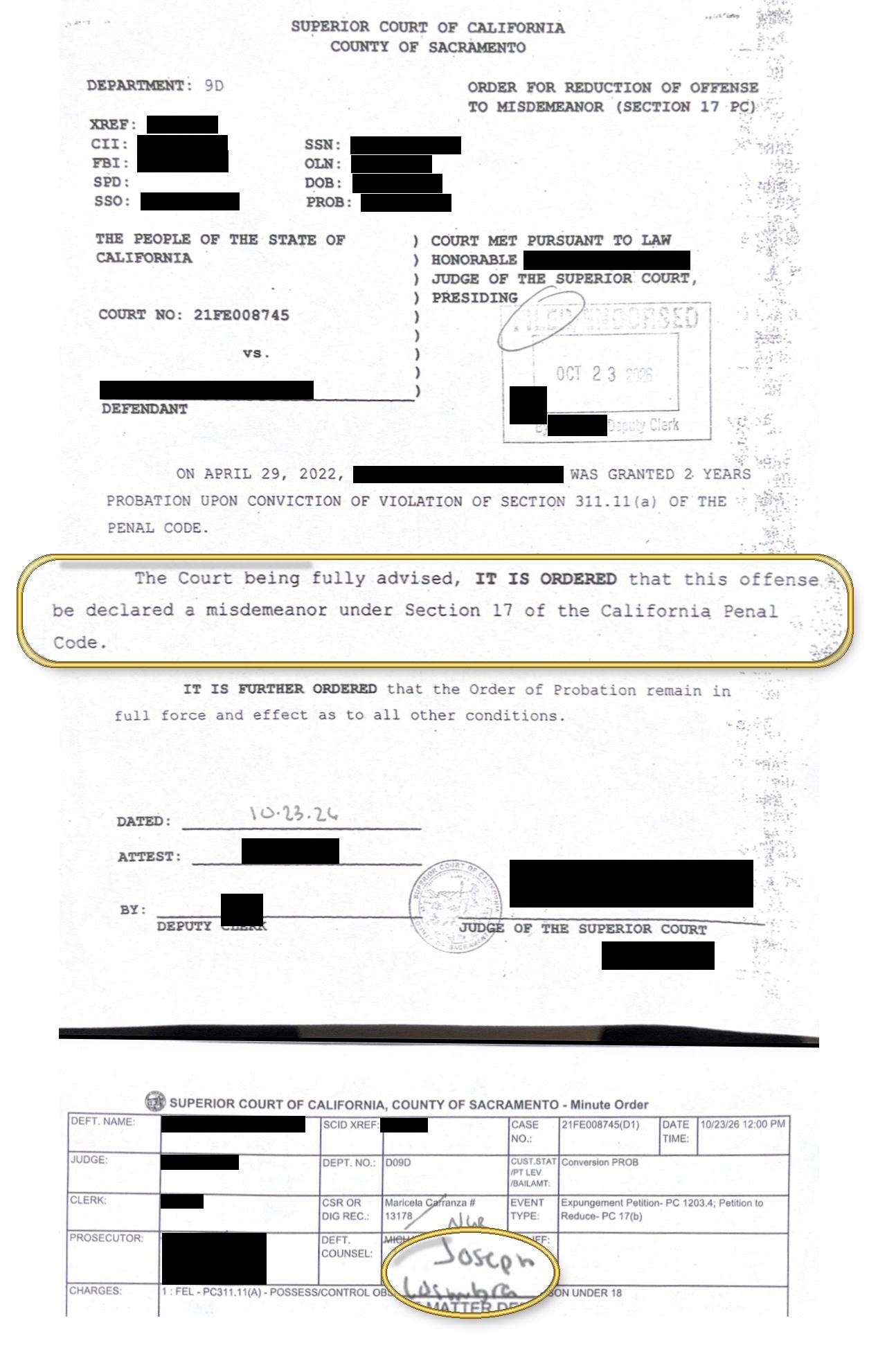
If you were convicted of a sex offense that California law treats as a “wobbler,” and the court placed you on probation, a judge has the power to reclassify that conviction as a misdemeanor. For some registrants, that change extends well beyond the label on a record. It can move a lifetime registration obligation toward one that a court can eventually bring to a close.
Many people still carry a felony label that shapes their registration status. Penal Code section 17(b) is one of the few tools that can change that label. Section 17(b)(3) states:
“When the court grants probation to a defendant and at the time of granting probation, or on application of the defendant or probation officer thereafter, the court declares the offense to be a misdemeanor.
In simple terms, if you received probation on a wobbler, you can return to court, even years later, and ask the judge to declare the offense a misdemeanor. We explain what a reduction can do for your tier, whether your conviction qualifies, when to file, and what happens after a reduction.
I. How a Misdemeanor Reduction can Lower Your Registration Tier
For most registrants, the reason to pursue a section 17(b) reduction is the tier system. California’s tiered registry ties strength of your registration obligation to your tier:
Tier One - 10 years
Tier Two - 20 years
Tier Three Lifetime
For example, a conviction pursuant to Penal Code Section 311.11(a), possession of child pornography, a violation of section 311.11 in Tier Three, which means lifetime registration. Section 290(d)(1)(A), by contrast, generally places misdemeanor convictions for registrable offenses in Tier One.
Picture a registrant whose only registrable conviction is a felony violation of section 311.11(a), with probation granted. If that Tier Three designation is predicated entirely on the felony classification, a successful section 17(b) reduction may support reassignment to Tier One. That is the difference between registering for life and becoming eligible to petition for termination after 10 years.
II. When your Tier stays the same
A reduction helps only when the felony classification is the reason for your tier. Your tier stays the same when the designation depends on a separate ground, such as:
-
A second registrable conviction that independently places you in a higher tier.
-
Your risk assessment. A person can be placed in Tier Three based on a well-above-average risk level on the State-Authorized Risk Assessment Tool for Sex Offenders, regardless of the offense.
-
A prior registrable conviction or a separate statutory ground that applies regardless of how the current offense is classified.
That is why we start with your Department of Justice tier-designation letter along with the conviction itself. Until we identify the specific ground for your current tier, we have no honest way to predict what a reduction will accomplish.
Even when the reduction does lower your tier, it shortens the wait for relief rather than ending registration outright. We cover that limit, and the others, later in this article. First, though, your conviction has to qualify.
III. Does Your Conviction Qualify?
Two requirements govern eligibility: the offense must be a wobbler, and the court must have granted you probation.
A. The Offense Must be a Wobbler
A wobbler is an offense the Legislature made punishable either as a felony or as a misdemeanor. Several registrable sex offenses are wobblers, including a violation of section 311.11(a), which allows either a country-jail term or a state-prison term.
The exact subdivision matters more than the name of the crime. Labels like “sexual battery,” “lewd acts,” and “possession” each cover several subdivisions with different punishments. Section 311.11 illustrates the point which is, subdivision (a) is a wobbler, while other subdivisions of the same statute carry harsher punishment. Your abstract of judgment or minute order shows the precise code section, and that section controls.
A straight felony, punishable only as a felony, falls outside section 17(b).
B. The Court Must Have Granted You Probation
Section 17(b)(3) applies only when the court granted probation. Since January 1, 2019, that includes cases in which the judge imposed a prison term and suspended its execution while placing you on probation. Assembly Bill 1941 removed the older requirement that probation be granted “without imposition of sentence” which had shut out many people with suspended sentences.
Two sentences fall outside the statute entirely:
- state-prison term actually served.
- A county-jail commitment pursuant to Penal Code Section 1170(h), including a split sentence.
If your case ended in either of those sentences, section 17(b) offers no route, and other forms of relief deserve a closer look instead.
A past probation violation is no automatic bar. The judge will weigh it, though, so we address any violation history directly in the motion.
IV. When to File
Section 17(b)(3) allows the request at the time probation is granted or at any point afterward, on application of the defendant or the probation officer. While there is no deadline, in practice, three windows exist:
a. At sentencing. Courts rarely grant a reduction at this stage in sex-offense cases, and prosecutors usually oppose it.
b. During probation. A request can succeed after a long stretch of full compliance, sometimes paired with a motion for early termination of probation pursuant to Penal Code Section 1203.3.
c. After probation ends. This is the most common window and usually the strongest, because the judge can see a completed record.
When both forms of relief are available, we often file the section 17(b) motion together with a section 1203.4 petition so a single hearing covers both.
Unpaid restitution is no obstacle by itself. Section 17 provides that an unfulfilled restitution order or restitution fine is no ground for denying a reduction.
VIII. What the Judge Considers
A reduction is discretionary. Research of the relevant case law yields that California appellate courts have directed trial judges to weigh the nature and circumstances of the offense, the defendant’s appreciation of and attitude toward the offense, and the defendant’s character as shown by behavior and demeanor, along with the general sentencing objectives in the California Rules of Court.
Prosecutors frequently oppose reductions in sex-offense cases, so it’s critical to present compelling, well-researched and evidence-backed argumentation to the court.
The strongest motions document:
- Successful completion of probation and any required treatment program
- Years since the offense with no new negative law enforcement contact including but not limited to the absence of arrests, charges, etc.
- Steady employment, education, and family responsibilities
- Completing character references from employers, treatment providers, clergy, or community members
- Concrete hardships that your felony classification has caused you, including nor limited to your heightened registration tier, lost employment, or housing barriers
IX. What Happens After a Reduction
Once the judge grants the motion, the offense becomes a misdemeanor for all purposes, with the important exceptions below. Your record reflects a misdemeanor, the maximum punishment for the offense becomes 364 days pursuant to Penal Code Section 18.5, and the felony-based firearm prohibition lifts. Some misdemeanors carry their own firearm restrictions, so we review that question separately.
X. Registration Continues
Penal Code Section 17(e) states that section 17 gives a judge no authority to relieve a defendant of the duty to register pursuant to Section 290 when the trier of fact found the defendant guilty of a registrable offense. A reduction leaves the registration duty itself in place. The real question becomes your tier and the length of your obligation.
XI. Requesting Tier Reassignment
The Department of Justice updates its records only after it receives the court’s order. After a reduction, we communicate directly with the California Department of Justice requesting the issuance of a revised tier level designation letter of Tier Level 1 that supersedes “Tier 3 - Lifetime” on the basis of the successful reduction from feeling to misdemeanor. In addition to issuance of the corrected tier assignment letter, the CalDoJ removes our clients’ Megan’s Law Website profiles.
XII. Petitioning for Termination
A reduction that lowers your tier assignment from Lifetime to Tier Level 1 yields registration termination eligibility at the completion of your retroactive ten year mandatory minimum reduction period. You must be current in your registration and free of pending charges, custody, and supervision when you file. Mind you this is to attain eligibility to be able to petition off the registry; removal from the registry is NOT automatic. Once the minimum registration period for your tier has run, you or your attorney may petition for termination pursuant to Penal Code Section 290.5 in the superior court of the county where you reside. The registering law enforcement agency and the district attorney receive notice, and the district attorney may request a hearing. The court grants the petition unless the prosecution shows that continued registration would significantly enhance community safety. More recently, prosecutors have begun opposing petitions because they disagree with a tier level redesignation. Though, as of the time of this writing, no prosecutor has been successful at thwarting our petitions after a tier level reduction, this area of the law continues evolving and undergoing appellate litigation such that it may become more difficult to obtain removal from the registry upon tier level reduction but fortunately that has not been our experience so far.
XIII. How We Can Help
With PC 290 Registrants, Cal. Pen. Code §17(b) reduction evaluations begin with our review of your wobbler penal code section and your conviction sentence. Once we’re determined that the misdemeanor version of your specific criminal conviction qualifies you for Tier Level Reduction, we can undertake representation of your case in the direction of a motion for reduction under Penal Code 17(b). Rather than merely some checking boxes on a judicial council form, our representation encompasses preparation of qualitatively and quantitatively voluminous legal motion work to cite the relevant case authorities and statutory authorities in a manner that exceeds simply establishing your eligibility. We always consider to what extent the prosecution can use anything from your original case or since your conviction to launch a successful objection to your reduction petition. Meticulously anticipating the government’s objections and preparing for them with compelling argumentation and supporting exhibits gives us an edge over other law firms that struggle in this area due to their lack of experience, thoroughness and focus in this area of the law.
If you carry a felony wobbler conviction and received probation, contact Second Chances Law Group for a confidential consultation. One hearing may be the step that turns a lifetime sex offender registration obligation into one with an end date.